


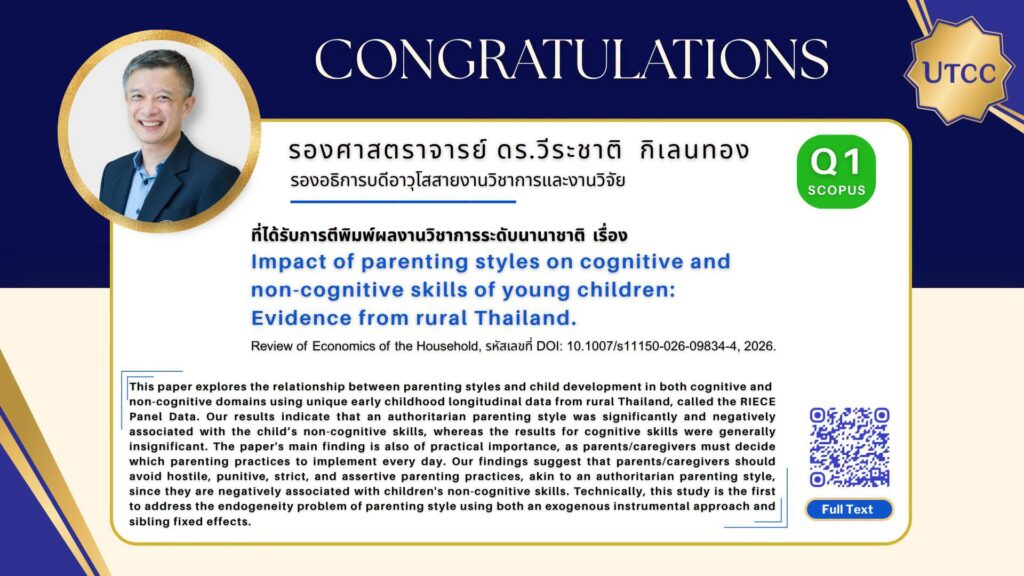
ขอแสดงความยินดี
รองศาสตราจารย์ ดร.วีระชาติ กิเลนทอง
รองอธิการบดีอาวุโสสายงานวิชาการและงานวิจัย
ที่ได้ตีพิมพ์ในวาสารระดับนานาชาติที่ปรากฏในฐานข้อมูล Scopus
วารสาร Review of Economics of the Household
รหัสเลขที่ DOI: 10.1007/s11150-026-09834-4
งานวิจัยชิ้นนี้เป็นส่วนหนึ่งของความพยายามทำความเข้าใจกระบวนการสร้างทุนมนุษย์ตั้งแต่ช่วงปฐมวัย ซึ่งเป็นช่วงเวลาที่ส่งผลต่ออนาคตของเด็กอย่างมาก ทั้งด้านการเรียน การทำงาน รายได้ และสุขภาพ งานวิจัยนี้ศึกษาว่า “วิธีเลี้ยงดู (parenting style)” ส่งผลอย่างไรต่อทักษะด้านความคิด (cognitive skills) และทักษะด้านพฤติกรรมและอารมณ์ (non-cognitive skills) ของเด็ก คำถามนี้มีความสำคัญเป็นพิเศษในบริบทชนบทไทย เพราะยังพบการลงโทษทางร่างกายและการดุด่าเด็กอยู่มาก อีกทั้งเด็กจำนวนมากอาศัยอยู่กับปู่ย่าตายายเนื่องจากพ่อแม่ต้องย้ายไปทำงานในเมือง
งานวิจัยนี้ใช้ข้อมูลจาก RIECE Panel Data (https://riped.org/data/riece-panel-data/) ซึ่งติดตามเด็กในจังหวัดมหาสารคามและกาฬสินธุ์เป็นประจำทุกปีตั้งแต่ปี 2559 กลุ่มตัวอย่างคือเด็กอายุ 5–11 ปี จำนวน 953 คน ผู้วิจัยแบ่งวิธีเลี้ยงดูออกเป็นสองแบบ
แบบแรกคือแบบเข้มงวดสั่งการ (Authoritarian) ซึ่งเน้นการดุด่า การลงโทษ และการสั่งโดยไม่อธิบายเหตุผล แบบที่สองคือแบบอบอุ่นมีเหตุผล (Authoritative) ซึ่งเน้นความใส่ใจ การอธิบายเหตุผล และการเปิดโอกาสให้เด็กมีส่วนร่วม จุดที่ทำให้งานนี้แตกต่างจากงานอื่นคือ ไม่ได้จัดผู้เลี้ยงดูแต่ละคนให้อยู่ในแบบใดแบบหนึ่ง แต่มองว่าผู้เลี้ยงดูทุกคนมีทั้งสองแบบในระดับที่มากน้อยต่างกัน จากนั้นจึงวิเคราะห์ความสัมพันธ์กับพัฒนาการของเด็กสองด้าน ด้านแรกคือทักษะด้านความคิด ซึ่งวัดจากการทดสอบเด็กโดยตรง ประกอบด้วยความจำใช้งาน (Working memory) และการยับยั้งชั่งใจ (Inhibition) ด้านที่สองคือทักษะด้านพฤติกรรมและอารมณ์ ซึ่งประเมินจากคำตอบของผู้เลี้ยงดู ประกอบด้วยการกำกับตนเอง (Self-Regulation) และทักษะทางพฤติกรรม (Behavioral Skills)
ผลการศึกษาพบว่า ยิ่งผู้เลี้ยงดูใช้วิธีเข้มงวดสั่งการมากเท่าใด เด็กยิ่งมีการกำกับตนเองและทักษะทางพฤติกรรมต่ำลง ผลนี้ยังคงอยู่แม้ผู้วิจัยจะทดสอบด้วยหลายวิธี รวมถึงการเปรียบเทียบระหว่างพี่น้องในบ้านเดียวกัน ในทางกลับกัน วิธีเลี้ยงดูแทบไม่ส่งผลต่อความจำใช้งานและการยับยั้งชั่งใจของเด็กวัยนี้ ส่วนผลของการเลี้ยงแบบอบอุ่นมีเหตุผลยังไม่ชัดเจน นอกจากนี้ ผลเสียของการเลี้ยงแบบเข้มงวดสั่งการยังรุนแรงกว่าในบางกลุ่ม ได้แก่ เด็กผู้หญิง เด็กที่อาศัยอยู่กับพ่อหรือแม่เพียงคนเดียว และเด็กที่ผู้เลี้ยงดูมีอายุระหว่าง 40–60 ปี
อย่างไรก็ตาม ผลการศึกษานี้มีข้อจำกัดที่ควรคำนึงถึงหลายประการ ประการแรก ทักษะด้านพฤติกรรมและอารมณ์มาจากคำตอบของผู้เลี้ยงดูเอง ผู้ที่เลี้ยงดูแบบเข้มงวดอาจประเมินพฤติกรรมเด็กในแง่ลบเกินจริง ประการที่สอง ผลการศึกษายังไม่อาจยืนยันความเป็นเหตุเป็นผลได้อย่างสมบูรณ์ ถึงกระนั้น งานวิจัยนี้ชี้ให้เห็นว่า การลดการดุด่าและการลงโทษทางกายอาจช่วยให้เด็กกำกับอารมณ์และพฤติกรรมของตนเองได้ดีขึ้น
———————————————————
This research is part of an effort to understand how human capital forms, starting in early childhood. These early years strongly shape a child’s future, including education, employment, earnings, and health. This study examines how parenting style affects children’s cognitive skills and their non-cognitive skills. This question matters especially in rural Thailand, where physical punishment and scolding of children remain common, and many children are raised by their grandparents because their parents have moved to cities for work.
The study uses data from the RIECE Panel Data (https://riped.org/data/riece-panel-data/), which has followed children in Mahasarakham and Kalasin provinces every year since 2016. The sample consists of 953 children aged 5 to 11. The researchers distinguish between two parenting styles. The first is authoritarian parenting, which involves scolding and punishment and gives orders without explanation. The second is authoritative parenting, which emphasizes warmth, reasoning, and involving the child in decisions. Unlike most other studies, this one does not place each caregiver into a single category. Instead, it assumes that every caregiver shows both styles to different degrees. The researchers then examine how these styles relate to two areas of child development. The first is cognitive skills, measured through direct assessment of the children, which include working memory and inhibition. The second is non-cognitive skills, assessed through caregiver interviews, which include self-regulation and behavioral skills.
The results show that the more authoritarian a caregiver is, the lower the child’s self-regulation and behavioral skills. This finding is robust across several methods, including comparisons between siblings in the same household. In contrast, parenting style has no significant effect on working memory or inhibition in children this age. Authoritarian parenting affects some subgroups more strongly than others. It negatively impacts girls, children living with only one parent, and children whose caregivers are between 40 and 60 years old more than the others.
The study has limitations to keep in mind. First, scores for non-cognitive skills come from caregivers’ own reports, so authoritarian caregivers may rate their children’s behavior more negatively than it really is. Second, the findings cannot fully establish cause and effect. Even so, the study suggests that reducing scolding and physical punishment may help children better regulate their emotions and behavior.